

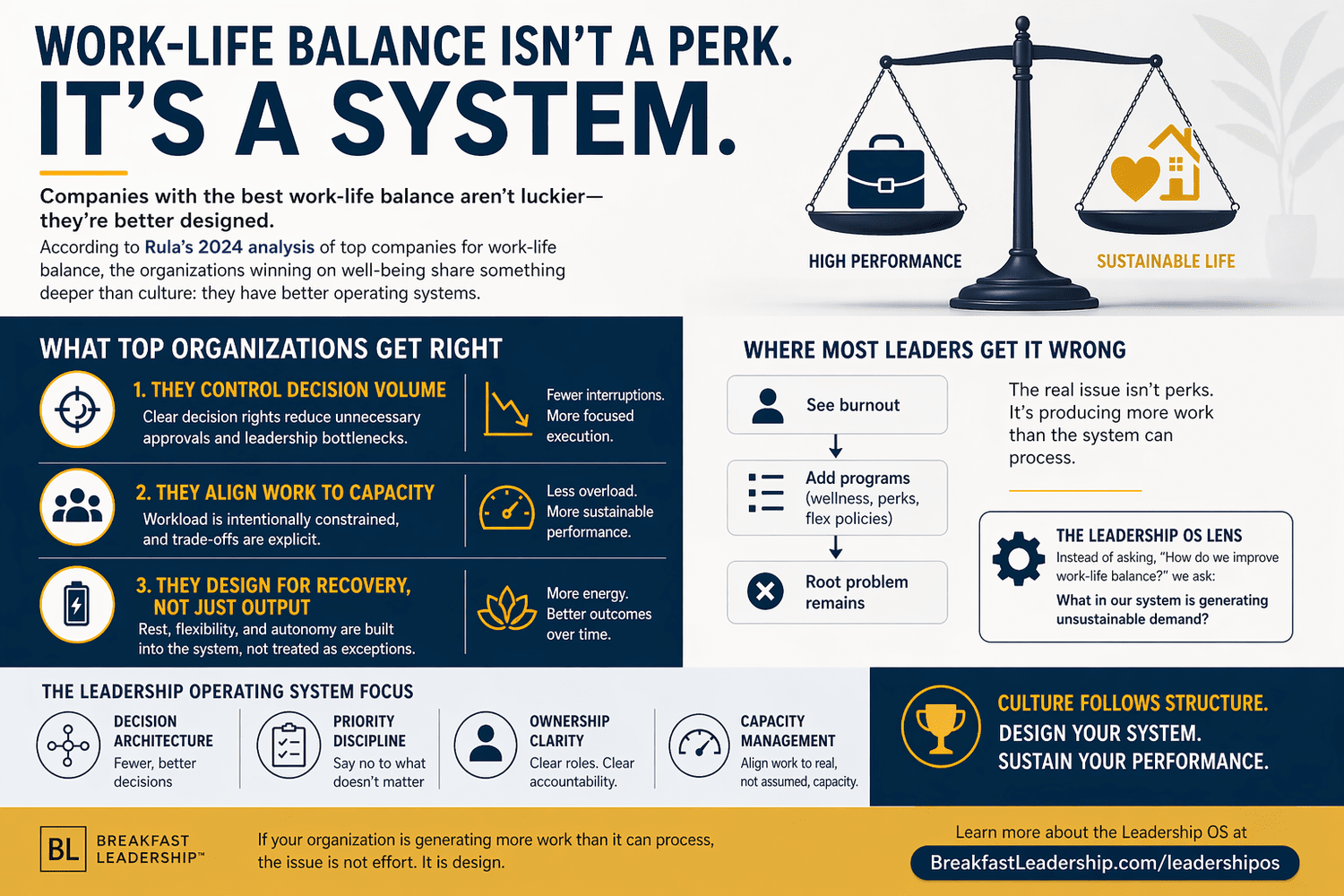
Organizations with strong work-life balance are not “nicer.” They are better designed.
The companies highlighted in Rula’s analysis of top work-life balance employers demonstrate something deeper than culture. They reflect intentional operating systems that reduce friction, clarify decisions, and protect capacity.
Most organizations try to solve burnout with policies. The leaders pulling ahead are solving it with systems.
Why Work-Life Balance Is a Leadership System Issue
The Rula research points to companies that consistently outperform on employee well-being. These organizations tend to share patterns:
-
Flexible work structures
-
Clear expectations around time and availability
-
Leadership behaviors that reinforce boundaries
-
Sustainable workload distribution
That sounds like culture. It’s not.
It’s system design.
Work-life balance deteriorates when:
-
Decision rights are unclear
-
Priorities shift faster than teams can respond
-
Work is added without removing anything
-
Leaders reward responsiveness instead of outcomes
This is not a people problem. It’s an operating model problem.
What High Work-Life Balance Organizations Actually Get Right
If you strip away branding and benefits, the top organizations in the Rula study are doing three things differently:
1. They Control Decision Volume
They don’t allow every issue to escalate.
Decision rights are clearly defined, reducing unnecessary approvals and leadership bottlenecks.
Result:
Fewer interruptions, less reactive work, more focused execution.
2. They Align Work to Capacity
They don’t treat employee capacity as infinite.
Workload is intentionally constrained, and trade-offs are explicit.
Result:
Teams are not constantly operating in overload, which is the primary driver of burnout.
3. They Design for Recovery, Not Just Output
They don’t assume productivity is linear.
Rest, flexibility, and autonomy are built into the system rather than treated as exceptions.
Result:
Sustained performance instead of short-term bursts followed by burnout.
Where Most Leadership Teams Get This Wrong
Most executives misdiagnose the issue.
They see poor work-life balance and respond with:
-
Wellness programs
-
Mental health days
-
Flexible work policies
Those are downstream interventions.
The upstream problem remains:
The organization is producing more work than it can process.
Without fixing that, every well-being initiative becomes cosmetic.
The Leadership Operating System Lens
A Leadership Operating System (LOS) reframes the issue entirely.
Instead of asking:
“How do we improve work-life balance?”
It asks:
“What in our system is generating unsustainable demand?”
This shifts focus to:
-
Decision architecture
-
Priority discipline
-
Ownership clarity
-
Workflow design
When those elements are structured correctly, work-life balance improves as a byproduct.
Diagnostic Questions for Executives
If you’re evaluating your organization through a Leadership OS lens, start here:
-
Where are decisions getting stuck or escalated unnecessarily?
-
How often are priorities changing without removing existing work?
-
Do teams know what not to do?
-
Is workload aligned with actual capacity, or assumed capacity?
-
Are leaders modeling boundaries, or breaking them?
If these answers are unclear, your system is driving burnout.
The Strategic Implication
The gap between organizations is no longer about benefits or policies.
It’s about operational clarity.
Companies that design for:
-
Fewer, better decisions
-
Explicit trade-offs
-
Clear ownership
-
Sustainable workload
Will outperform those that rely on culture alone.
Because culture follows structure. Not the other way around.
Where This Connects to the Leadership Operating System
At the Breakfast Leadership Network, this is exactly what the Leadership Operating System addresses.
It is not another framework layered on top of your organization.
It is the system that defines:
-
How decisions are made
-
How priorities are set
-
How accountability flows
-
How capacity is managed
Without this, burnout is inevitable regardless of intent.
With it, performance becomes sustainable.
If your organization is generating more work than it can process, the issue is not effort. It is design.
You can review your current system here:
https://BreakfastLeadership.com/leadershipos
FAQ
Are work-life balance rankings a reliable indicator of performance?
They are a leading indicator of system health. Organizations with sustainable workloads tend to outperform over time.
Can culture alone fix burnout?
No. Culture reinforces behavior, but systems determine what behaviors are possible.
What is the fastest way to improve work-life balance?
Reduce decision friction and enforce priority discipline. This immediately lowers unnecessary workload.
How do you know if your system is the problem?
If your teams are consistently busy but outcomes are inconsistent, your system is likely misaligned.
Conclusion
Work-life balance is not created through intention.
It is produced through structure.
And the organizations getting it right are not managing people better.
They are operating differently.