

The most striking row is Relationship Building. Employees with this dominant strength who spend energy considering how coworkers feel about a stressful situation actually see their own burnout symptoms get worse, not better, by a wide margin. Their instinct pulls them the wrong direction entirely.
This matters for any executive rolling out AI tools. Gallup’s data was gathered before generative AI reshaped daily workloads, but the underlying finding holds: what feels like the natural response to overwhelm is often not the response that works. If your organization’s only burnout strategy is telling people to “build resilience” or “use the tools better,” you’re leaning on instinct in a moment that calls for structure.
Why Individual Coping Can’t Absorb a Structural Problem
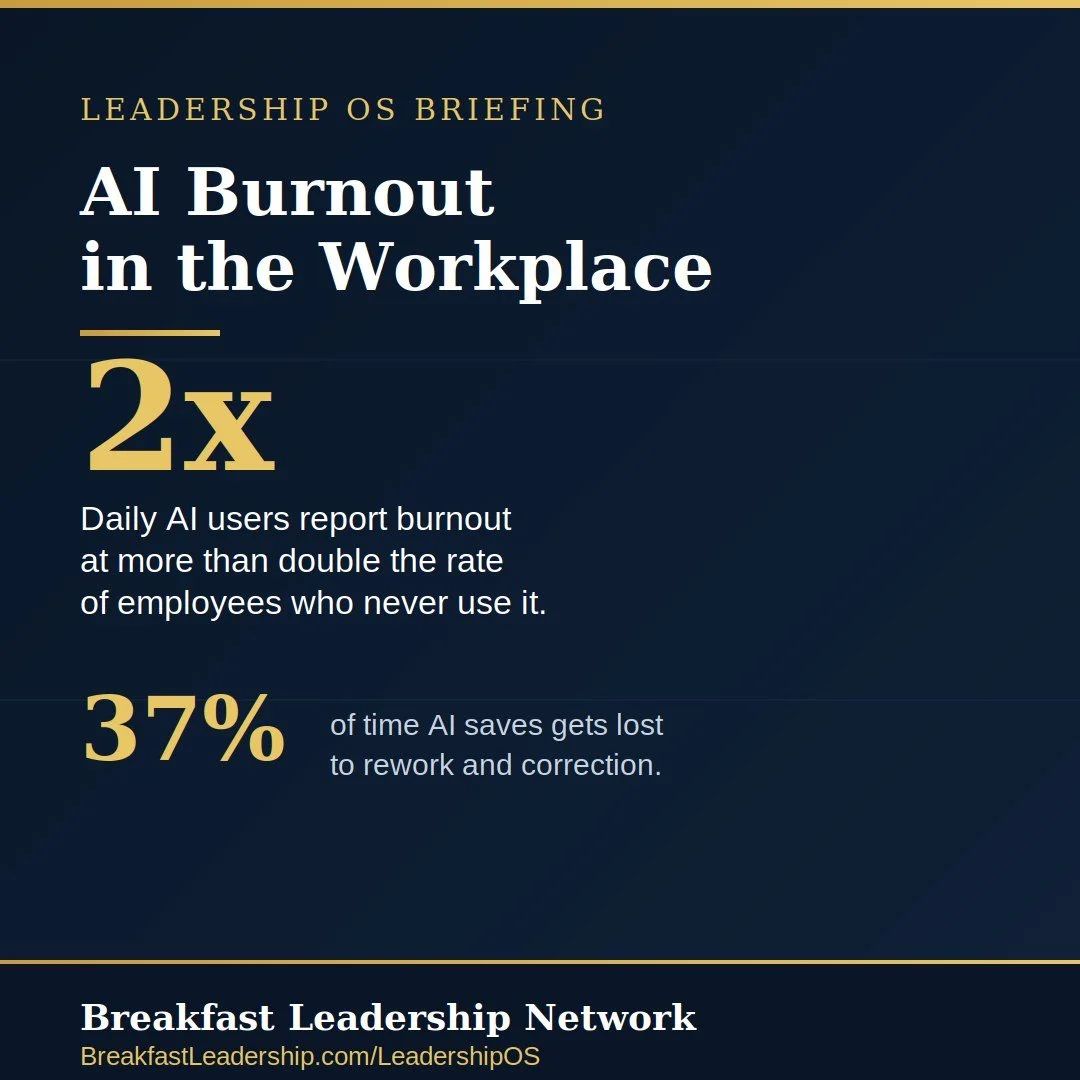
Gallup’s own research elsewhere backs this up. Roughly 28 percent of workers report feeling burned out very often or always, and only 24 percent say they rarely or never feel it. That’s the baseline before layering in an AI rollout that, per multiple 2026 studies, is expanding scope and blurring the boundary between focused work and constant oversight.
The uncomfortable truth for leadership teams: coaching individuals to cope better with a broken system produces marginal, short-lived gains. As I’ve written before, burnout isn’t a self-care deficit, it’s a systems failure, and the data on the infinite workday shows exactly how communication architecture without boundaries produces exhaustion at scale, with or without AI in the mix. AI just raises the stakes and shortens the runway.
Leaders are not exempt. Leadership burnout has climbed to 53 percent among managers, and a burned-out leader who is also the one setting AI adoption targets is a compounding risk, not a containable one.
The Leadership OS Fix
Wellness stipends and resilience training address the symptom. The Leadership OS framework addresses the structure that produces the symptom in the first place, built on three pillars:
Decision clarity. Before rolling out any AI tool, define what “done” looks like and who owns quality control. Ungoverned AI output shifts labor downstream to whoever has to review it. Decision clarity means that shift is planned, not accidental.
Operational rhythm. Build regular checkpoints, not just AI adoption dashboards, that measure rework hours, focused-work ratios, and whether your team is completing tasks inside normal working hours. What gets measured gets managed, and workload health is no exception.
Culture infrastructure. Give people permission to name when an AI tool is creating more work than it saves, without that becoming a performance mark against them. Psychological safety is the mechanism that surfaces workslop before it becomes a retention problem.
None of this requires slowing AI adoption. It requires redesigning the workload that surrounds it, the same discipline I outline in Burnout Proof and apply with executive teams building their own Leadership Operating System.
If your organization is deploying AI faster than it’s redesigning the work around it, that gap is where burnout lives. Explore the Leadership OS framework and build the structural fix before your best people quietly disengage, then quietly leave.